Thursday, March 31, 2022

Musings: When Killing Characters to Save the World, Do it in Pairs


Pop quiz, hotshot. There's a bomb in the center of the planet and your best friend is dying. Save your friend and the bomb goes off. What do you do? What do you do?

My last post looked at episode 3 of Star Trek Picard's second season. In it the crew faced the challenge of having to disconnect a Borg queen that was draining the ship's power before one of the crewmen dies from a phaser wound. At one point one of the crew decides to shoot the queen only to be instructed not to by Picard because she is necessary to repairing the timeline from diverging into a dark, xenophobic horror show.

The episode generated discussion of how lazy writing didn't force Picard into a choice between fixing the future and saving the crewman, therefore letting him off the hook for the crewman's death. Except, as I pointed out, Picard made his choice by instructing his subordinate not to kill the queen when it looked like that was the best, most expedient way to stop the power drain and save the dying crewman. He decided that when it came down to it, the queen's value to the mission was more important than his friend's guaranteed survival. There was no need to stop the crew's frantic efforts just to ask Picard a question and wait for him to answer it, especially since Picard as a character had developed over eight seasons of television (and four movies) so his decision would never really be in doubt. But what if the character who was confronted by this decision was someone the audience didn't know?

Monday, March 28, 2022

On Elnor's Death and Raffi's Rage


The current crop of Star Trek series on Paramount+ frequently face heavy criticism by corners of Trek fandom for being inferior to previous incarnations, especially '90s shows The Next Generation, Deep Space Nine, and Voyager. Negative criticism focuses on different things, but the "writing" is often a large target. The writing is lazy, or it's bad, or it's full of bad characterization, or it has no larger meaning, or...or...or...You get the idea. To be sure, Discovery, Picard, and Lower Decks have their writing challenges at different times. But as a frequent re-watcher of all Trek series, I can confidently say that people who act like those three series consist of over 150 episodes written under divine inspiration are wearing rose colored glasses. Suffice it to say, these generic old vs. new writing criticisms can often be unserious and unfair. Not surprisingly, with the second season of Picard underway, these debates are in full swing.

The following post will include spoilers for seasons one and two of Picard.

Friday, March 25, 2022

Congratulations! You Survived Onslaught

Art by Andy Kubert

I read Onslaught as it came out in 1996 but had not revisited the entire event until recently for my issue-by-issue commentary on Twitter and this retrospective. While I did remember that the event was flawed--especially the ending--I have always viewed it through the rose colored glasses of nostalgia. That said, Onslaught is much maligned and has a horrible reputation as one of the worst examples of the substanceless events that Marvel became known for in the mid and late 1990s. Given all of that, I worried going in that not only would rereading Onslaught turn into an unfun slog, but also that I'd simply end up trashing issue after issue in a retrospective that no one would ever want to subject themselves to. I'm happy to say the experience actually wasn't that bad.

X-Men 56
Onslaught is definitely not top tier material. There's no way to overcome the flaws that completely undermine the character and the story in the final issues, and parts of the story leading up to that ending are incoherent. At its heart Onslaught suffers from two fatal flaws: the writers never seemed to know what Onslaught was or what he wanted, and the event wasn't created to be a story so much as a means to an end for a problem Marvel hadn't yet solved.

Its Flaws

I extensively talked about the way the final two issues of this event damaged Onslaught as a character in the Phase 2 entry. I also posted commentary on Twitter about both X-Men 56 and Onslaught Marvel Universe. In short, the Nate Grey plot hole, Onslaught's admitted lack of a plan to achieve his original goal, and his abrupt change to a goal completely detached from his original dark mirror version of Xavier's dream speak to a writing team that never understood the character they created (which isn't really surprising since they created him as a means to an end rather than a character in his own right). Onslaught's ending relies entirely on the main villain being admittedly stupid, and character stupidity is a terrible thing to have a plot rest on. But as bad as Onslaught's damaged character development is, it's a minor problem compared to the those created by the reason the event even exists.

Tuesday, March 22, 2022

Onslaught Retrospective 5: Epilogue

Art by Andy Kubert

Onslaught Marvel Universe tried to end the event with a bang, but the abrupt way everything happens combined with the shallow emotions connected to it really send it out with more of a whimper. The issue's final pages insist the story's conclusion is significant. Nate Grey holds Xavier and looks over the ruined Central Park while he offers a tribute to the lost heroes (who he never really knew and who's fight and sacrifice he didn't witness). The final page features Franklin Richards standing over the word "Imagine" and holding his soon-to-be ever-present blue ball. The story's end provides just enough information through narration to establish that Franklin somehow saved the heroes, so it's not hard to conclude that the ball is the Heroes Reborn universe that all those heroes are bound for. The X-Men do ponder how human mutant relations will sour because onlookers will think they killed all the other heroes, but this isn't something that is actually seen in the issue. But in the end all of this is rushed and underwhelming with the Franklin reveal completely undercutting the emotional value of the heroes' "deaths." Fortunately there is an outstanding epilogue.

Comic book crossovers sometimes suffer from rushed or outright nonexistent aftermaths that can make it seem like there are no significant consequences. If one were to stop reading at Onslaught Marvel Universe, that would seem to be the case. However, a makeshift epilogue of six issues (though only one is branded as such) spends time with the X-Men as they recover from the events of Onslaught and also with the mysterious Bastion as the lead up to Operation: Zero Tolerance begins. I've grouped together the following six issues (listed in a suggested reading order) as an epilogue to Onslaught.

                X-Men Unlimited 12         Cable 36                      Uncanny X-Men 337
                X-Men 57                            Onslaught Epilogue     X-Men '96

Cable 36
Loose Ends

X-Men Unlimited 12 is unusual in that it can be put anywhere in the Onslaught timeline after Uncanny X-Men 335. It follows Juggernaut as he struggles to escape from the Crimson Gem of Cyttorak that Onslaught stuck him inside of in X-Men 54. The conflict with Onslaught isn't mentioned at any point now nor do the X-Men appear. As a result I've placed the issue here rather than interrupt the narrative flow of the event. The issue itself is somewhat unremarkable. There are a few insightful character moments for Juggernaut, but the most significant story point is the introduction of the god Cyttorak who tries to inhabit Juggernaut in order to escape the crystal into the real world. Cyttorak will be used in future stories that see Juggernaut sometimes heroic.

Saturday, March 19, 2022

Onslaught Retrospective 4: Phase 2

Art by Andy Kubert

Considering its lengthy build up, it’s a surprise that Onslaught only lasted two months. For as big a story as it tried to tell, the event is shockingly short. Even more surprising is that in its second month, only five issues out of nineteen are essential (if we assume phase is primary and impact secondary). For the purposes of this retrospective, though, I moved six issues from the event’s second month to Phase 1 and another issue to the Epilogue in an attempt to establish an ideal continuity. As a result, Phase 2 consists of the following issues (listed in a suggested reading order). Some issues have minor significance while others have none.


                          Uncanny X-Men 336      Cable 35      X-Force 58
                        Incredible Hulk 445        Iron Man 332     Avengers 402
                        Thor 502      X-Man 19             Wolverine 105
                        Fantastic Four 416      X-Men 56              Onslaught Marvel Universe

Uncanny X-Men
Cable 35
336 brings us back to Xavier who remains trapped inside Onslaught (alongside Franklin). Thor eventually rescues Xavier by forcibly ripping him out of
, but Onslaught is able to survive without Xavier as a host because he merged the minds of Xavier and Franklin and transformed himself into a higher form. This is inconsistent with X-Men 55 where Onslaught needed Franklin to be proactive to exploit his powers. After Xavier is rescued, Onslaught again unleashes one of his catastrophic psi blasts–this time with the heroes in close proximity to him–and yet, for the sixth time, no one is disabled or even seriously injured.

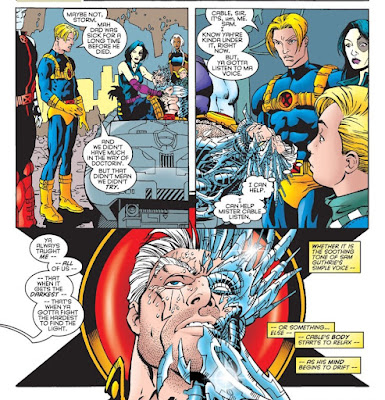
In the aftermath of this devastating assault that doesn’t devastate, Sue Storm and Cable embark on a mission to rescue Franklin in Cable 35. Apocalypse takes action for the first and only time in the event when he teams up with the two heroes. The mission’s failure is a foregone conclusion because Apocalypse predictably betrays Cable and Sue by trying to kill Franklin. Apocalypse and Cale’s belabored mutual distrust telegraphs the ending making the story feel like an attempt to justify Apocalypse’s inclusion in Onslaught rather than a necessary plot point.