Tuesday, April 19, 2022

A Close Look at DMZ part 4: The Matty - Free States Meet Cute


Despite his living in a warzone, what we've seen of Matty Roth's life hasn't been that bad. He has been in danger, even mortal danger, but that doesn't differentiate him from most of the DMZ's residents. So far in Matty's short stay he's been able to do the work he stayed in the DMZ to do, and he's made friends, or at the very least companionable associates, along the way. But being a somewhat public figure in an ungoverned territory dominated by disparate factions and sandwiched between two hostile armies pretty much guarantees that even that limited amount of freedom and autonomy was in danger of being hijacked at some point. And that's exactly what happens in the series' second multi-part story arc, "Body of a Journalist".

Five issues isn't much time to set a tone, but DMZ actually managed to do that with its opening issues. I talked about how chalk full of world building and ancillary character development the opening story arc "On the Ground" was. When Matty chooses to stay in the DMZ at the end of issue three we have a little bit of an expectation of what he's in for and what he's set out to accomplish. "Ghosts" is an excellent follow-up where we get to see Matty actually trying to be the journalist he agreed to try to be. And while "Crosstown" doesn't really advance the journalism idea, it almost suggests that the series could just be Matty's ongoing adventures in the DMZ, exploring the warzone without significantly influencing it--kind of a travelogue. "Body of a Journalist" arrives at the perfect time to declare that no, Matty Roth is probably going to be a big deal in the DMZ.

The following will contain spoilers for DMZ 6-10.

Proof of Life and Death

"Body of a Journalist" opens having taken a noticeable time jump from the previous issue. In "Crosstown" there was still snow on the ground while here the series has moved into summer. And it turns out that summer in the DMZ is always marked by an increase in violence. Liberty tries to convince Matty to come in so they can replace him with a veteran reporter, but Matty refuses insisting he is safe and has built up useful contacts. But for all his bluster, the DMZ is getting to him. After witnessing a random suicide bombing Matty reflects on how the horror of the environment is wearing on him. And this emotional weariness is unfolding at the same time as he's dealing with a decidedly unfun infection that's presumably a result of the city's less than stellar sanitation. So needless to say, Matty isn't in a happy headspace as the story gets underway.

Sunday, April 10, 2022

A Close Look at DMZ part 3: Press Pass


DMZ
starts off with a bang in "On the Ground." It doesn't happen through big action set pieces and explosions (though part 3 certainly has those), but rather by packing rich, intense character development and world building into every panel. No moment is wasted, and it makes an impression on the reader that all but demands the series be added to pull lists. There is, though, a drawback to this intensity.

The first three issues of DMZ really never lets Matty stop and rest. If he's not avoiding getting shot, he's being dragged from one part of the city to another by Zee, who is busy telling him that everyone outside the DMZ has wrong ideas about what goes on inside it. A byproduct of this pacing is that the reader really never gets to catch their breath--never really gets to think about what's going on. The counterpoint of issues four and five, then, are a welcome shift.

The following will contain spoilers for DMZ 4-5.

Issue 4, "Ghosts", opens with Matty in a snow covered Central Park. Or at least a snow covered expanse where Central Park used to be. The would-be reporter has traveled several miles up from the Lower East Side searching for the Ghosts, a rumored special ops team that wanders the DMZ and that Matty believes is likely made up of AWOL soldiers who are, according to rumors, based around Central Park.

Wednesday, April 6, 2022

Review - Amazing Spider-Man "Beyond": The Rise and Fall of Ben Reilly...Again


What kind of story is more compelling: a hero rising back up after a fall or a hero at the top of his game taking that fall? The first arc provides us with both the satisfaction of a character persevering and overcoming as well as a brief moment of seeing good triumph. On the other hand it can be just as interesting to watch a very successful character face challenges they can't resolve and see how they confront their darkest days.

Amazing Spider-Man recently showcased two heroes taking these different journeys simultaneously in its "Beyond" storyline thanks to the return of Ben Reilly, Peter Parker's clone from the mid 1990's infamous Clone Saga. Ben's first death at the end of the Clone Saga came after he and Peter had grown into essentially being brothers. Prior to his death he had demonstrated that he was every bit a Spider-Man as Peter was. Since Ben's return, though, his characterization and relationship to Peter has swung in different directions--sometimes wildly so--at the whims of his writers, never reflecting the character he was at the time of his first death. Regardless of one's opinion of how Ben is depicted, he's really the only character that can truly serve as an inverted mirror to Peter: high while Peter is low, falling while Peter is rising.

"Beyond" runs for nineteen issues of Amazing Spider-Man from 75-93 (plus multiple ancillary issues) and was published three times a week. The story was written by a team consisting of Saladin Ahmed, Patrick Gleason, Jed MacKay, Kelly Thompson, Geoffrey Thorne, Zeb Wells, and Cody Ziglar. The three times a week schedule necessitated an art by committee situation. "Beyond" wasn't a continuation of anything from Nick Spencer's run on Amazing Spider-Man so it's a great jumping on point. Likewise it's not necessary to have read any of Ben Reilly's previous appearances; the story provides the small amount of backstory that is necessary to understand the character's history.

Monday, April 4, 2022

A Close Look at DMZ part 2: Dropping in on the DMZ


Maybe the most important thing to accomplish in the beginning of any story is establishing the world in which it takes place. For something set in a world that's basically contemporary Earth with nothing supernatural or superpowered going on, that's fairly easy. The further you get from the everyday, though, the more complicated this can be. Then the question becomes how to do it. Some stories take a lot of time in the beginning to establish characters' surroundings and larger world, laying the ground work for when the reader finally encounters these things down the road. The other option is to drop the reader into a world and have them rely on context clues and snippets of information provided by characters and events to discover what's going on. It's this second option, arguably the riskier, that Brian Wood chose when he wrote DMZ.

The following will contain spoilers for DMZ 1-3.

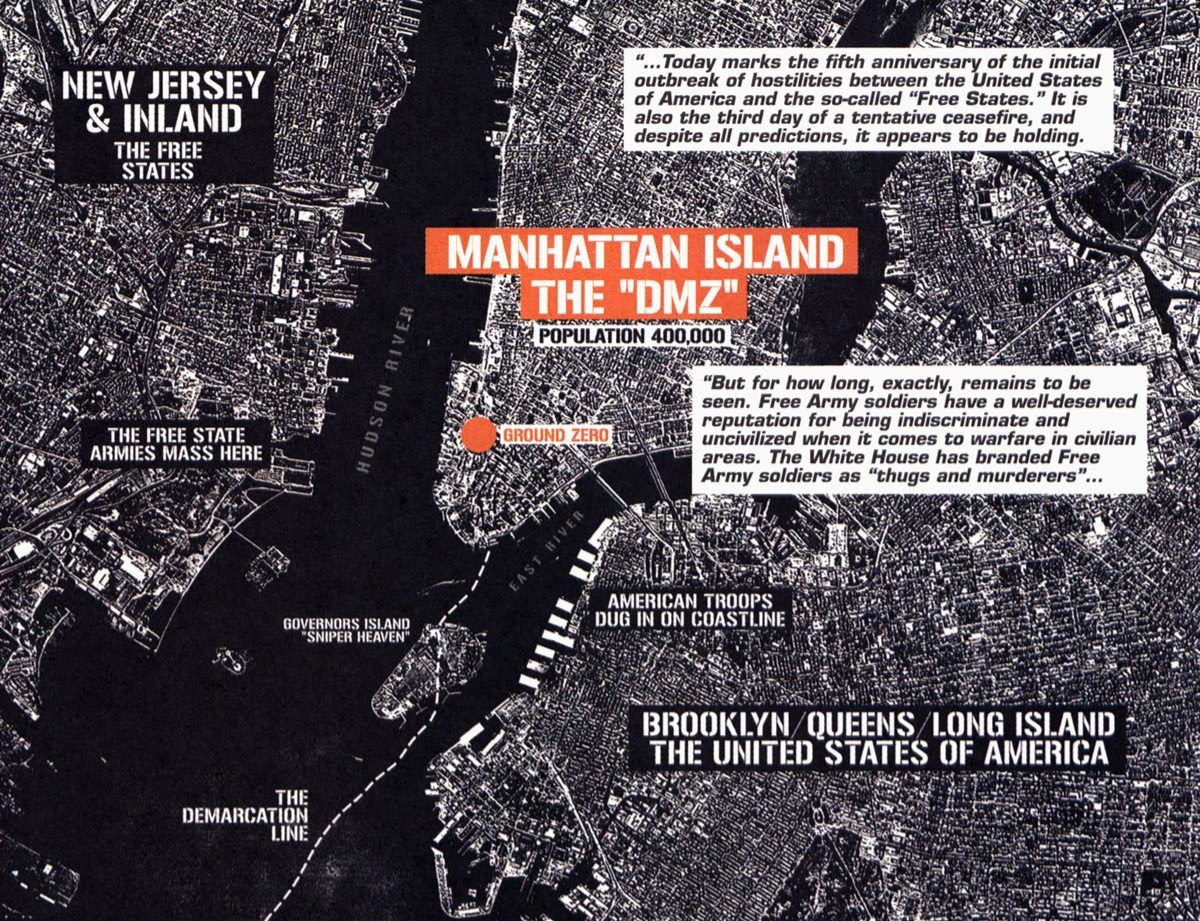
In the Introduction I covered the concept of the world in broad strokes. And broad strokes are just what Wood uses to start the series. A very simple map on the first page establishes that there's a conflict of some kind, that forces for the participants in that conflict (the United States and Free States) are in positions of opposite sides of Manhattan, and that the island of Manhattan is a vaguely ungoverned "DMZ." Since the series' title is DMZ, it's reasonable to assume that's where the series takes place. But that's it. There's nothing else.

This lack of information isn't so bad, though, because we get introduced to our point of view character immediately. Counterintuitively, that character is not a resident of the DMZ--someone who could more or less take the reader by the hand and lead them through this new world.

We immediately meet Matty Roth, a young man who's expecting to be a photography intern for Liberty News. Instead he's been roped into working with well known journalist Viktor Ferguson who's about to leave to do a feature in the DMZ while there's a ceasefire in place.

Matty's introduction is as vague as the DMZ's. In most ways he's a blank state. We can infer a little bit from his dialogue: that he is/wants to be a photographer and that the DMZ is not a safe place to go in his eyes. The lack of information about Matty in some ways lets him be a stand-in for us. We know roughly as much about the DMZ as he does so right from the start we're standing alongside him, learning as he learns.

A Close Look at DMZ part 1: Introduction


An unfortunate and too common misconception about comics, even by some readers, is that they are relatively shallow entertainment. They may be able to tell intricate, longform stories but in the end they have no greater meaning (nor should they). Except one really doesn't have to go far to see how wrong that is. Even the bright, exciting world of superhero comics is full examples of these stories. And while there are those who believe this is a relatively new phenomenon because some current series, such as Superman Son of Kal-El, are more overt with their larger messages, the truth is that this has been going on pretty much since the beginning of the genre. Two obvious examples are X-Men, a series that has long used metaphor to comment on civil rights issues, and the character of Captain America who represents the spirit and ideal of the United States and who has often come into conflict with the nation's government when he it id not living up to those espoused principles. So, if superhero books with their fun, exciting, larger than life stories can tread into the territory of societal commentary and critique, imagine what series outside that genre can do.

In 2005 DC Comics' imprint Vertigo began publishing a series called DMZ. At the time of the series' launch George W. Bush was president, the Iraq had grown unpopular, 9/11 and the threat of terrorism still held sway in the public consciousness, and the country had traded away certain civil liberties in the name of security. DMZ was an unapologetically political series. Among the topics its stories commented on were the military, the media, extreme jingoistic patriotism, terrorism, art, and business corruption. And lest someone think a comic addressing these kinds of real world issues can't last, it's important to point out that DMZ ran for 72 issues from 2005 to 2012.